We've witnessed a rapid evolution in AI applications, moving from simple copilots to more sophisticated agent systems. This shift hasn't happened in isolation; it's been driven by advancements in language models and a growing appetite for autonomous AI solutions in the business world. But what is an agent in terms of technical implementation, and how do we navigate the challenges of building production-ready agent systems?
The Current Landscape
The agent ecosystem has exploded across multiple categories. Startups are building horizontal platforms to enable business users to create and configure their own agents:
- BREVIAN: No-code AI agent platform automating business processes
- ema: AI-powered digital employees for task automation
- Relevance AI: Customizable AI agents for various business applications
Frameworks are emerging for developers to build their own agents:
- LangChain: Python library for creating language model-powered applications
- LlamaIndex: Python library for building agents that interact with external data
- CrewAI: Framework for orchestrating "crews" of agents
- AutoGPT: Open-source framework for autonomous GPT-4 agents
Additionally, companies are developing vertical solutions for specific use cases:
- Hebbia: AI-powered research and analysis for financial services
- Harvey: AI legal assistant for law firms
This all sounds promising... if it works.
So What Is an Agent?
At their core, agents are systems that can take user input (structured or unstructured), process it through a series of steps, and produce an output. They typically consist of three main components: tasks (user instructions), memory (data storage), and tools (functions they can execute).
When you break it down, this current structure isn't too different from a traditional backend server:
- User requests come in with some input and some context (tasks)
- Data is stored and retrieved (memory)
- Various functions are called to process the request (tools)
- Communication between "agents" in multi-agent systems is done through API calls or a shared data store (e.g., message queue)
Instead of tightly typed API endpoints, we're dealing with natural language.
An Engineering Perspective
From an engineering standpoint, agents are systems enabled by large models to perform tasks that historically required human intervention or extensive custom logic. What sets them apart are key characteristics:
- Non-deterministic behavior: Agent-driven systems can produce varying outputs for the same input, mimicking human-like variability
- Continuous learning: They adapt and improve based on interactions and feedback
- Progressive autonomy: Handling increasingly complex tasks with less oversight over time
- Bounded autonomy: Despite their capabilities, agent-driven systems should operate within defined parameters to ensure safety and reliability
Challenges with Agent-Driven Architectures
As we move from theory to implementation, several technical challenges emerge. The specific hurdles you'll face depend on your use case, but some common themes arise:
1. Fault Tolerance
Traditional fault tolerance relies on well-defined procedures, but agents introduce new complexities. How do we balance error correction with an agent's adaptive capabilities? Developing strategies for maintaining system stability in the face of unpredictable behavior is crucial. This requires robust monitoring and logging systems to track agent decisions and actions, allowing for better error detection and recovery.
2. Scaling
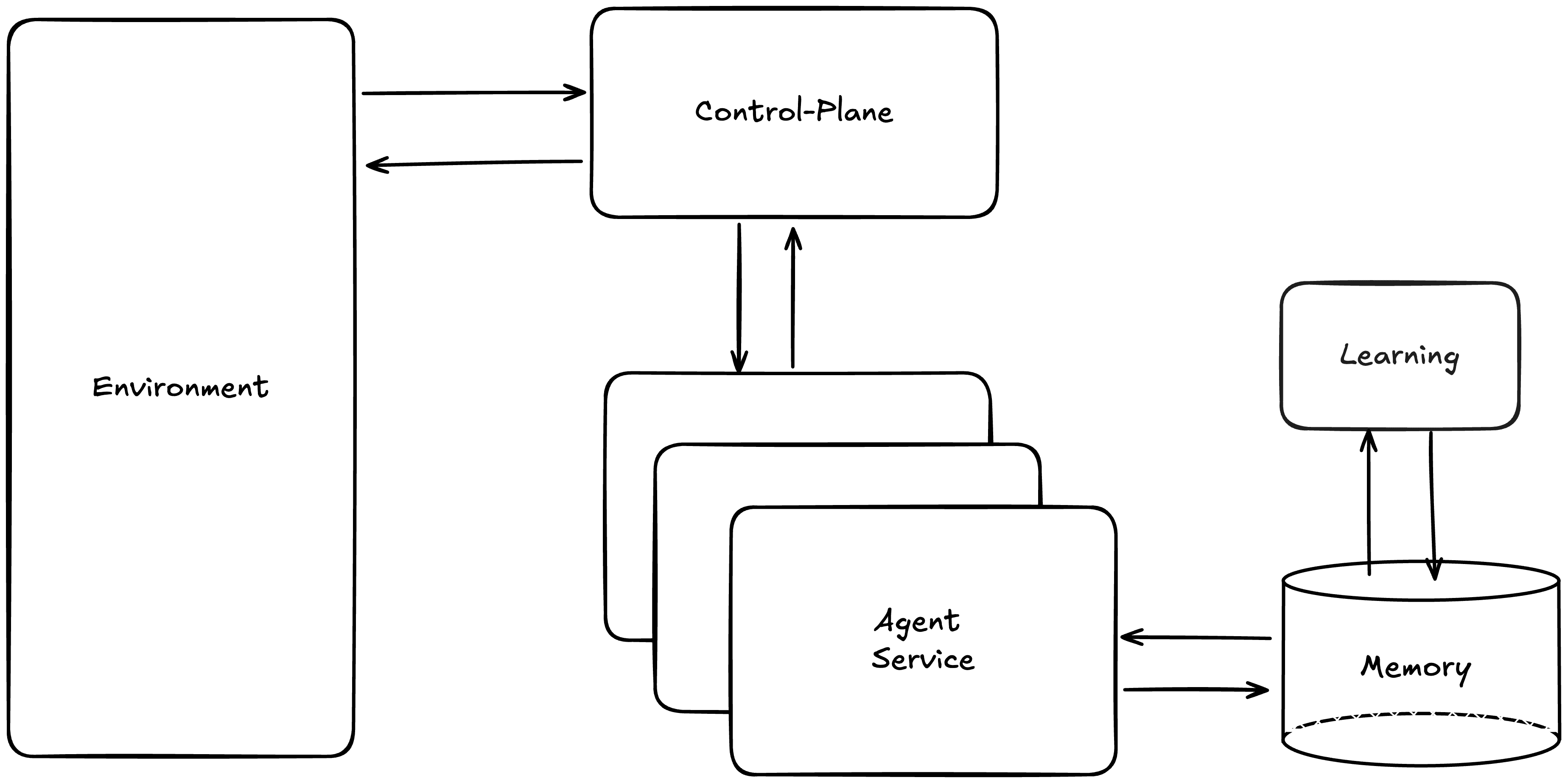
Moving beyond single-machine implementations introduces more challenges. Efficient task delegation across multiple agents may require exploring distributed computing paradigms like map-reduce. We might also consider event-driven architectures inspired by control-plane/data-plane models (where the control-plane manages overall system state and the data-plane handles individual tasks).
3. Data Management
As agent systems become more complex and as companies scale their usage of agent-driven systems, handling data becomes a critical concern. The ability to fit everything into memory or context windows can quickly become a limiting factor. Moving towards structured formats, similar to data frames in data science or tables in databases, could enhance interoperability. A structured approach would add more deterministic behavior to agent systems, but it also presents its own set of challenges and limitations.
4. Human-in-the-Loop
Effective human oversight is crucial in agent-driven systems. This involves defining clear triggers for human intervention based on confidence levels or specific scenarios. The system must balance agent autonomy with necessary pauses for human decision-making in critical situations. Designing intuitive interfaces for human-agent collaboration is essential, providing transparency into agent reasoning and facilitating effective interaction between human operators and AI agents.
Agents in Practice: Productivity and Enterprise Applications
The most promising applications of agents today are in productivity and enterprise workflows. Rather than attempting to replace entire job functions, successful agent implementations augment human capabilities in specific, well-defined tasks. In B2B SaaS contexts, agents excel at:
- Automating repetitive data entry and processing tasks
- Synthesizing information from multiple sources for decision-making
- Managing complex workflows across different systems
- Providing intelligent assistance for domain-specific problems
The key is building agents that operate within clear boundaries while still providing meaningful value. As these systems mature, we're seeing a shift from fully autonomous "do everything" agents to specialized agents that work alongside humans, handling specific aspects of larger workflows.
What's Next?
What excites me about where this is all going is the potential to learn from historical executions and make better decisions on the fly. A system powered by a large language model could potentially improve its performance over time, learning from specific tasks or user preferences without explicit code.
Perhaps "Agents" aren't meant to replace our existing services entirely. Instead, they represent a new architectural approach that can work alongside and enhance our current systems. So, what is an agent, really? It's a complex, adaptive AI system that pushes the boundaries of traditional software architecture. Agents offer exciting possibilities for more flexible, intelligent, and capable systems, but they're not a one-size-fits-all solution.
By thoughtfully navigating these challenges and understanding what truly defines an agent, we can harness their power to create innovative solutions – while avoiding the pitfalls of reinventing the wheel or over-engineering our systems.
Further Reading
If you're interested in diving deeper into AI agents: